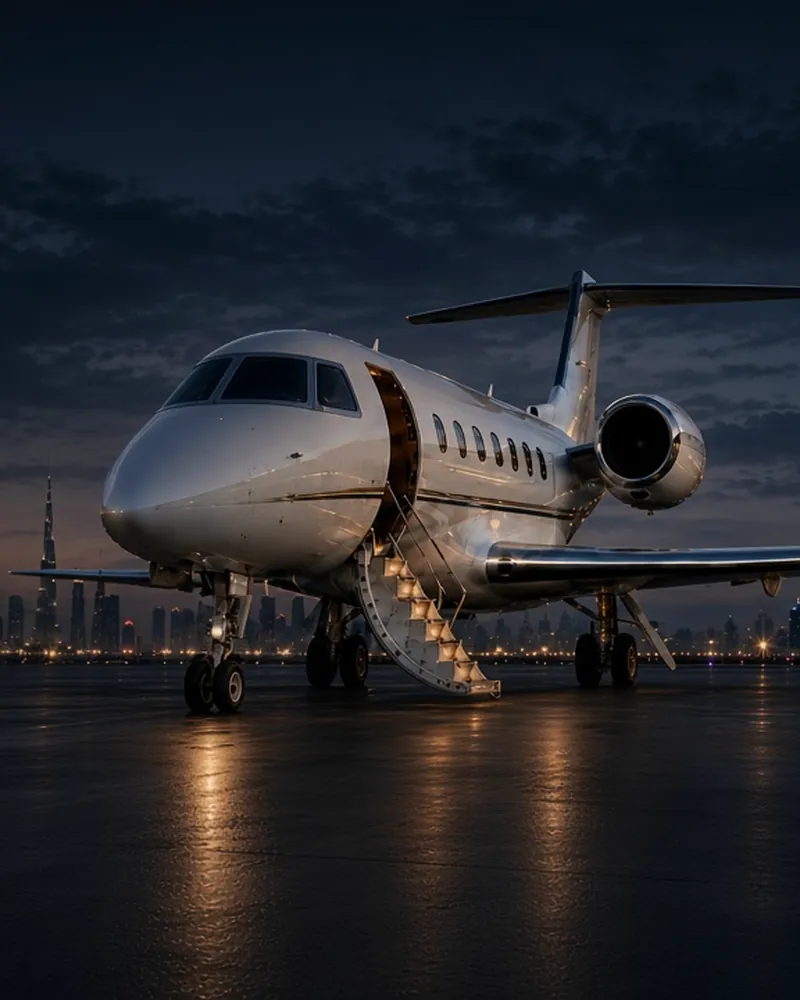
The classes at a glance
Ranges are manufacturer figures in still air with a partial passenger load; a full cabin, headwinds and hot or high airports shorten them. Seat counts and cabin heights are typical; individual aircraft vary by configuration. The specific aircraft is confirmed with the operator when you receive a quote.
| Class | Seats | Range | Cabin height | Typical aircraft |
|---|---|---|---|---|
| Turboprop | 6–9 | ~2,900–3,300 km | ~1.45 m | Pilatus PC-12 NGX, King Air 350i / 360 |
| Very Light Jet | 4 | ~1,800–2,200 km | ~1.40–1.50 m | Phenom 100, Citation Mustang |
| Light Jet | 6–8 | ~3,700 km | ~1.45–1.55 m | Phenom 300E, Citation CJ3+, Pilatus PC-24 |
| Super Light Jet | 6–8 | ~3,700–3,850 km | ~1.50 m | Learjet 70 / 75 |
| Midsize Jet | 7–9 | ~3,400–4,700 km | ~1.70–1.75 m | Citation XLS+, Hawker 800XP |
| Super Midsize Jet | 8–10 | ~5,900–7,400 km | ~1.83 m | Challenger 350, Praetor 600, Citation Longitude |
| Heavy Jet | 10–14 | ~7,400–8,300 km | ~1.85–1.90 m | Challenger 605 / 650, Falcon 900EX, Gulfstream G450 |
| Ultra Long Range | 12–19 | ~11,100–14,350 km | ~1.88–1.96 m | Global 6000 / 7500, Gulfstream G650 / G700, Falcon 8X |
| VIP Airliner | Typically up to 19 | ~5,800 km | ~2.1–2.25 m | ACJ319, Boeing BBJ, ACJ320 |
For indicative hourly rates in each class, see what a private jet charter costs.
Turboprops
Propeller aircraft driven by turbine engines. Slower than jets, but they reach airfields jets cannot.
Turboprop
Aircraft such as the Pilatus PC-12 NGX and King Air 350i cruise at around 500–580 km/h and operate from short, unpaved or steep-approach strips — including Courchevel’s altiport, which jets cannot use. On legs under about 90 minutes the time lost to a jet is small, and the hourly rate is the lowest of any class.
- Best for: Island hops, mountain airfields and regional business trips.
- Keep in mind: Seated cabin only; strong headwinds lengthen the flight more than on a jet.
Very light and light jets
The short-haul end of the jet market, and a frequent choice for trips within Europe.
Very Light Jet
The Phenom 100 and Citation Mustang carry up to four passengers in a compact cabin and are certified for single-pilot operation. They make efficient work of short city pairs, with the smallest cabin volume and baggage space among jets.
- Best for: One to three passengers on flights under two hours.
- Keep in mind: Limited luggage — soft bags travel better than large hard cases.
Light Jet
The Phenom 300E, Citation CJ3+ and Pilatus PC-24 carry six to eight passengers over roughly 3,700 km, enough for almost any city pair in Western Europe or along the US East Coast non-stop. The PC-24 adds short and unpaved runway capability. This is the workhorse of intra-continental charter.
- Best for: Two to six passengers on flights of up to about three hours.
- Keep in mind: Cabin height around 1.5 m: comfortable seated, not a stand-up cabin.
Super Light Jet
The Learjet 70 and 75 sit at the top of the light segment, with a range similar to other light jets, a fast climb and a certified ceiling of 51,000 ft. Production ended in 2022.
- Best for: Light-jet trips of up to about four hours.
- Keep in mind: Cabin is not stand-up height; check the aircraft’s age and refurbishment.
Midsize and super midsize jets
Where the cabin becomes a room: more height, an enclosed lavatory and room to work.
Midsize Jet
The Citation XLS+ and Hawker 800XP offer a cabin height of about 1.7 m, an enclosed lavatory and a light galley, over ranges of 3,400–4,700 km — London to Istanbul, or New York to Miami, without a stop.
- Best for: Groups of up to eight on flights of three hours and more.
- Keep in mind: Taller passengers will still stoop; a super midsize is the first true stand-up cabin.
Super Midsize Jet
The Challenger 350, Praetor 600 and Citation Longitude have a flat floor and a stand-up cabin of about 1.83 m, seat eight to ten, and fly 5,900–7,400 km. That covers North America coast to coast and Europe to the Middle East non-stop.
- Best for: Long continental flights of four to eight hours.
- Keep in mind: Widely chosen for its balance of comfort and cost, so availability tightens on peak dates.
Heavy and ultra-long-range jets
Wide cabins in several zones, built for crossing oceans and flying through the night.
Heavy Jet
The Challenger 605 and 650, Falcon 900EX and Gulfstream G450 offer a wide cabin in separate zones, a full galley and seats that convert for rest. Ranges of 7,400–8,300 km reach transatlantic city pairs such as London–New York, about 5,550 km.
- Best for: Families, delegations and overnight flights up to about ten hours.
- Keep in mind: Chosen for cabin and range rather than speed; some airfields are too short.
Ultra Long Range
The Global 6000 and 7500, Gulfstream G650 and G700 and Falcon 8X fly 11,100–14,350 km at high cruise speed, with up to four living areas and a dedicated crew rest. The longest-range models link city pairs such as London–Singapore or New York–Dubai, about 11,000 km, non-stop.
- Best for: Intercontinental flights where a fuel stop is not acceptable.
- Keep in mind: The highest hourly rate; the gain over a heavy jet shows on legs beyond eight or nine hours.
VIP airliners
Airliner airframes fitted out as private residences.
VIP Airliner
The ACJ319, Boeing BBJ and ACJ320 offer a lounge, dining area and bedroom, often with a shower. Most are configured for up to 19 passengers, because above 19 passenger seats EASA and FAA rules require certified cabin crew; larger layouts exist and fly with cabin crew. The gain over an ultra-long-range jet is cabin space rather than range.
- Best for: Heads of state, sports teams with staff, and trips where the cabin is the point.
- Keep in mind: Needs airline-scale airports and handling; few airframes, so book early.
How to choose the right class
The class is the answer to four questions. We ask them before proposing an aircraft, so the cabin follows the trip rather than a fixed roster.
How far, and is a stop acceptable?
Treat the brochure range as a ceiling. If the distance is close to it, a fuel stop or the next class up is the honest answer.
Who and what is travelling?
Passenger count is only half of it. Skis, golf bags, hard cases and pets decide whether a cabin works as well as the number of seats.
Which airports?
Runway length, steep approaches such as London City, high altitude, curfews and slots all limit which aircraft can operate a given trip.
How long on board?
Under two hours, a seated cabin is fine. From three hours, stand-up height and an enclosed lavatory matter. Overnight, flat beds and crew rest do.
Questions about private jet types
What size of private jet do I need?
For up to six passengers on flights under about three hours, a light jet is usually right. Choose a midsize or super midsize jet for longer continental flights or when you want an enclosed lavatory and more headroom, and a heavy or ultra-long-range jet for ocean crossings and overnight flights.
From which class can you stand up in a private jet?
From the super midsize class, with a cabin height of about 1.83 m. Midsize cabins are around 1.7 m; light jets, very light jets and turboprops are seated cabins of roughly 1.4–1.55 m.
How many passengers can a private jet carry?
Typically four on a very light jet, up to about 14 on a heavy jet and up to 19 on ultra-long-range jets and most VIP airliners. Above 19 passenger seats, EASA and FAA rules require certified cabin crew, which is why most business-aviation cabins are configured for 19 or fewer.
Which private jet flies the furthest?
The newest ultra-long-range types, such as the Bombardier Global 8000 and Gulfstream G800, are rated at about 14,800 km (8,000 nm), with the Gulfstream G700 close behind. Few of the newest airframes are available for charter so far; ultra-long-range charters more commonly use the Global 6000 or 7500, Gulfstream G650 or Falcon 8X.
Why is the real range shorter than the brochure figure?
Published ranges assume still air, a light payload and standard reserves. A full cabin and luggage, winter headwinds, alternate airports and hot or high departure airports all reduce what an aircraft can fly non-stop.